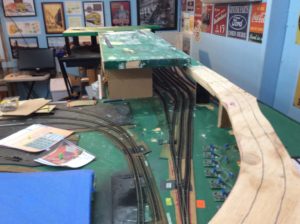
Phase II Trackwork FINISHED !!
Recording the progress of building the Denver’s RailRoads N Scale layout
All genuine posts are welcomed and will be acknowledged. Please submit your first post by email to: dennis@denversrailroads.com
Phase II Trackwork FINISHED !!
OK. All of the track laying for phase II is finished, which is a good thing given that I only have a dozen pieces of flex-track left.
I am now deep into the wiring of the motors in Denvers yards (what was phase four) while John is finishing installing SEEP point motors on the main line past the East Denver Belt line leading into Denver’s yards from Glenwood Springs (the old phase two).
Once we have all of the point motors wired up we can concentrate on the BUS wiring, which is complicated in Denvers yards as there is a return loop which will require a PSX reversing unit.
Phase II . . . Only 6 tracks left to lay
Finished installing the last of the turnouts in D&RGWs North Yard last night. Only have the 4 service tracks and 2 industry tracks left to lay.
Then it is onto wiring, wiring and a lot more wiring. Model RailRoading is fun! Still I am looking forward to constructing the control panels. Best part (together with scenery) of the hobby for me.
New areas to explore include controlling main line turnouts via DCC and installing signals. I found a really nice 3 light Chinese made N Scale signal (3 pack) at Amazon for only $11AUD each. Normally N Scale signals cost around $30 each so I have 27 more in transit to me. Plus I have 20 Drawf N Scale Signals (in packs of 10) coming for installation at DUT as part of Phase III.
Phase III Update
Thanks to the hard work of Rod and John all of the Denver Union Terminal (DUT) tracks have been laid and SEEP turnout motors have been installed – wired and tested – under the baseboard. Now onto the laying of the tracks for C&S’s Rice Yard and the passenger coach yards.
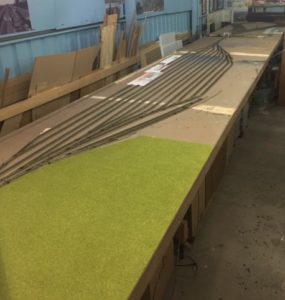
Phase II . . . almost there
This photo was taken 4 days ago. Since then I have laid a further 3 turnouts to the Holcim Cement and Hadley Auto Transport industry tracks in D&RGWs North Yard. These tracks will also act as Rio Grande Motorway tracks as required. That leaves 3 more turnouts for the D&RGW/Rock Island locomotive servicing tracks and the Pikestuff Small Enginehouse.
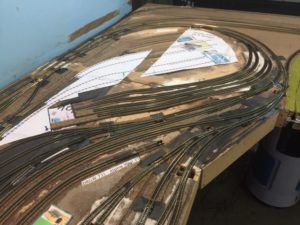
Then I can connect the remainder of the Kato extender tracks across the module 6 & 7 divide, patch up a couple of broken tracks and start making connections to the control panels, starting back at Black Hawk. Once all of the feeders are connected to the BUS it should be possible to run a train around the loop.
I have updated the main web site to reflect the 4 phases, instead of 5, of the layout construction mentioned in the last post.
Phase II and Phase IV combined into Phase II; Phase V becomes Phase IV
The main line between Glenwood Springs and the Wye at Denver Union Terminal (DUT) is almost complete. I just have to install the Wye track to the north of DUT, (the connection to the east is already laid), and relay two or three turnouts on the main at the Prospect Junction end of North Yard. Then I can connect the remainder of the Kato extender tracks across the module 6 & 7 divide, patch up a couple of broken tracks and start making connections to the control panels, starting back at Black Hawk. Once all of the feeders are connected to the BUS it should be possible to run a train around the loop.
The changes to the Phase numbers will be reflected in the main web site pages in the fullness of time. Reducing the number of Phases to four will align with the planned N-Scale magazine articles.
New Year (January 2019) Update
Although some weeks have gone by, little has changed since the November update. The magazine article has been completed and should be published in the May/June edition of the N-Scale magazine. Rod is still working hard on pre-wiring the turnout motors for Phase III – Denver Union Terminal (DUT). Both John and Rod are currently on holiday.
I have made a breakthrough with the installation of KATO extender tracks between the Belt Line module and the North Yard module in Phase II. I have successfully installed Kato extenders on 4 tracks which paves the way for continuous loop train running. However when I went to lay more track in the yards I realised that because the module is against the wall it will not be possible to install point motors from underneath the baseboard because you cannot reach or see the top of the tracks. It is ok to “pop-up” the baseboard for BUS wiring. Consequently I have began to raise up the turnouts, one by one, and install PECO point motors attached to the turnouts. This has the advantage that once track laying is complete, wiring the turnouts to the control panels is a relatively quick job.
Once the yard tracks, turnouts and motors are installed I will work backwards along the main line to Glenwood Springs. With regard to the mainline all of the turnouts are to be computer controlled, which means that a number of DCCconcepts AD-S8sx decoders will need to be installed, together with NCE BD-20 block detectors. The Grand Junction loop turnouts will also have to be rewired with AD-S8sx decoders and 14 more NCE BD-20 block detectors added. Once complete testing with JMRI Panel Pro and Railway & Co can commence.
Phases 1 to 5 November 2018 update
I am not sure anyone reads this Blog except of course the Web Robots. If you do read the blog please register and make a comment, or send me an email. However the blog was started as a useful place to record the progress on my layout, so I will keep updating every so often.
Phase 1 – the Clear Creek RR continues to progress. All track is laid. All turnout motors are installed. By the end of today all of the BUS wiring will be complete. Golden Station building is complete and five other kits have been completed. In addition the scenery work and ballasting has been completed on the canyons west of Golden. The scene is ready for photographs to be taken for an upcoming magazine article, except for the addition of some model people. This will happen once they arrive by mail from the USA in about 3 weeks time. Two new control panels for Black Hawk (Power District 2c) and Idaho Springs (Power District 2b) are ready and awaiting artwork and connections. Golden is in Power District (PD) 2a, Glenwood Springs in PD2 and the Grand Jct Loop in PD1.
Work will shortly commence on adding the industries and rolling stock into the “Ship It” Prototypical Switch List Generator program.
Phase II – the Main Line from Grand Jct Loop to D&RGW North Yard. All track laying and BUS wiring is complete, and in the process of being tested. The point motors have been installed and are currently being connected to the Power District 2 & 3 control panel and to Relay switches which will change the lights on the control panel to indicate direction. 30 NCE BD-20 track detectors have been purchased for installation in the return loop and the main line. An NCE AIU01 Auxiliary Input Unit has been purchased to link the track detectors with the Railway & Co “Train Controller” computer system.
East Denver Belt Line – all track has been laid and most of the turnouts will be controlled by Caboose Industries ground throws.
Phase III – Denver Union Terminal (DUT). Rod has finished laying track in the main station complex. Installation of the point motors has commenced. This is expected to take some considerable time. When the track BUS and point motors have been tested we will carry on installing the C&S/CB&Q Rice Yard, the coach yards and industrial branches.
Phase IV – D&RGW North Yard and industries and the UP 36th Yard. All work is on hold pending the completion of the work on Phase II as above.
Phase V – the D&RGW Main Line from Denver to Glenwood Springs and a branch line to Craig. Peter has laid all of the cork roadbed for this phase and I have finished the Gore Canyon scenery for the time being. Track laying for this phase will begin after phases 3 and 4 are complete.
Phases 1 to 5 July 2018 update
Phase 1 – the Clear Creek RR is progressing very well. All track is laid. All turnout motors are installed. Golden branch is completely wired. Scenery work has started on the canyons west of Golden. Ballasting of Golden yard is about to commence. Golden Station building is complete and two other kits have been painted and are ready for gluing. Two new control panels for Black Hawk and Idaho Springs are ready and awaiting artwork.
Phase II – the Main Line from Grand Jct Loop to D&RGW North Yard. All track laying and BUS wiring is complete, and ready for testing. Main line point motors are yet to be installed. East Denver Belt Line – all track has been laid and most of the turnouts will be controlled by Caboose Industries ground throws.
Phase III – Denver Union Terminal (DUT). Rod continues to lay track. Both of the scissors crossings are installed and most of the main tracks. It is beginning to look very impressive due to the length of station trackage.
The following sections are now part of Phase III:
(1) UP/CB&Q 23rd St Shops & D&RGW/CB&Q Coach Yards – connects with the Denver Union Terminal. Work will be started once the DUT trackage is complete.
(2) C&S Rice Yard – connects with the Denver Union Terminal. Work will be started once the DUT trackage is complete.
(3) UP Wynkoop St Branch – Gary has stated both the cork roadbed and the track laying at the North end of the Denver Union Terminal.
4) D&RGW Burnham Shops – this section will not be started until phase 4 and the rest of Phase 3 has been completed.
Major surgery to Phase 3 & 4 Benchwork modules:
Most of module 5 (the corner section with the passenger Y and loop trackage and industries within the loop) has been bolted onto module 6, which is now a little too heavy for one man to lift. The ends of the D&RGW and C&BQ coach yards, which commenced in module 4 and ends on module 5 have now been cut away and bolted onto modules 2, 3 & 4. This is a two man lift.
Phase IV – is now divided into the following sections:
(1) D&RGW North Yard – most of the North Yard track has been laid. As this module bridges the Phase II and East Denver Belt Line track with the Phase III Denver Union Terminal trackage, special trackwork for bridging the gaps will be required. Kato extended track pieces are currently favoured as the solution between:
- Modules 8 & 9 (Phases 1 & 2)
- Modules 6 & 7 (Phases 2 & 4)
- Modules 4 & 5 (Phases 3 & 4)
- Modules 1 & 2 (Phase 3)
(2) D&RGW North Yard Industries and trackside buildings.
(3) UP 36th Yard – adjacent to the D&RGW North Yard.
Phase V – the D&RGW Main Line from Denver to Glenwood Springs and a branch line to Craig. Peter has laid all of the cork roadbed for this phase and I have almost finished the Gore Canyon scenery (see an earlier blog). Track laying for this phase will begin after phases 1 and 4 are complete.
Phase One Reset !!!
Phase 1 of the layout started out life as the DC controlled Argentine Central Railway running Atlas Shays of the same roadname. Unfortunately it is too hard to install a DCC decoder in an Atlas Shay so I looked around for an alternative railroad to base phase 1 on. Having purchased two Model Power 2-6-0s and 4-4-0s with DCC and sound in CB&Q with “Burlington Route” logos on the tenders, modeling the Colorado & Southern (C&S) seemed a good idea. My first thought was to switch to the Golden and Ralston Railroad which ran out of Golden from 1877 to 1898. Go to http://denversrailroads.com/GRR.htm for more details of that line. However there was very little information available about that line or its track-age so I decided instead to model the Clear Creek Railroad, a C&S narrow gauge line that ran from Golden to Black Hawk and Idaho Springs until 1941. Thanks to the extensive writing of Harry Brunk in the Narrow Gauge and Short-Line Gazette and others there is a lot of information available about the Clear Creek Railroad, including the Black Hawk track arrangements.
Before I made the change I gave a lot of thought to the Denver’s RailRoads layout and discovered that the D&RGW Aspen Branch continued as a standard gauge line until 1991. However after a lot of track planning I came to the conclusion that the track arrangement did not fit the track that was already planned as part of the original Argentine Central layout. Furthermore I had the four Model Power steam locomotives in the “Burlington Route” roadname and a lot of 1930 era reefers, boxcars, tank cars and stock cars that I really wanted to run.
Consequently I have gone back to the Clear Creek RailRoad (CCRR) layout, running to Black Hawk and Idaho Springs. I have now laid all of the track, including the short branch line from Golden to Idaho Springs and the much longer branch line with a 3-4% grade to Black Hawk. This arrangement will allow me to either run the CCRR as a stand alone C&S 1930s steam only layout or as a branch of the “modern” 1950-60s C&S, ignoring the little fact that the line was removed in 1941. In both cases the Coors Brewery will be a center piece of the railroad, either with billboard Reefers and boxcars or with 40′ piggyback trailers and covered hoppers.
Phase V Benchwork Completed
All of the benchwork for Phase V is now complete. Below is Gorge Canyon, (between Kremmling and Bond) where the foam scenery supports will be installed ahead of the trackwork, so as to minimise the mess that will be created during construction of the 200-300 (15″ to 22½”) foot mountain side above the Canyon. The actual canyon walls were 1000 feet high. That is 75″ in N Scale which while doable would be out of proportion with the rest of the layout. The Colorado river will be modelled on the lower part of the benchwork.
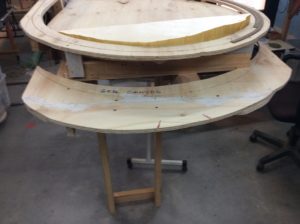
Below is the baseboard for the town of Craig in Colorado. The Craig branch from Bond is still an active coal branch on the Denver & Rio Grande Western.
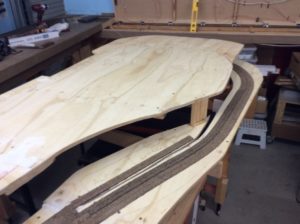
Below is the foam base for the Aspen branch line from Glenwood Springs. This branch line was built by the Denver & Rio Grande Western in order to tap silver mines in the area around Aspen and was completed in 1887. The line saw significant business in its first few years, but as the silver boom tapered off, traffic along the line declined. Ultimately, the portion of the line south from Woody Creek to its end at Aspen was abandoned in 1968 and the rest of the line in 1995. As Denver’s Railroads is set in the period 1947-1963 for Passenger traffic and 1968-1969 for freight traffic the Aspen branch was still an active railroad, with passengers, coal, cattle, sheep, poultry, petroleum, perishables and explosives (dynamite) being the main commodities carried.