Introducing the new . . . Rock Island Sandown Layout
Recording the progress of building the Denver’s RailRoads N Scale layout
All genuine posts are welcomed and will be acknowledged. Please submit your first post by email to: dennis@denversrailroads.com
Introducing the new . . . Rock Island Sandown Layout
As mentioned in the June 2026 update blog I have began the planning of a new 4′ x 8′ (with a staging extension) N scale layout that I can build inside my house and will enable me to achieve, be it on a smaller stage, a number of modelling activities (eg weathering, signaling, auto train control, scenery and kit building) currently awaiting the completion of at least the wiring of the Denver’s RailRoads layout, which is now unlikely to ever happen.
My trackplan is based on an original 3′ x 7′ N scale layout heavily featured on a YouTube channel called the “Chicago Crossing Model Railroad” see – https://www.youtube.com/@ChicagoCrossingRR/featured and a version of the track plan using Kato Unitrack at https://www.steves-trains.com/post/n-scale-track-plans.
This is the original Kato Unitrack version of the trackplan:
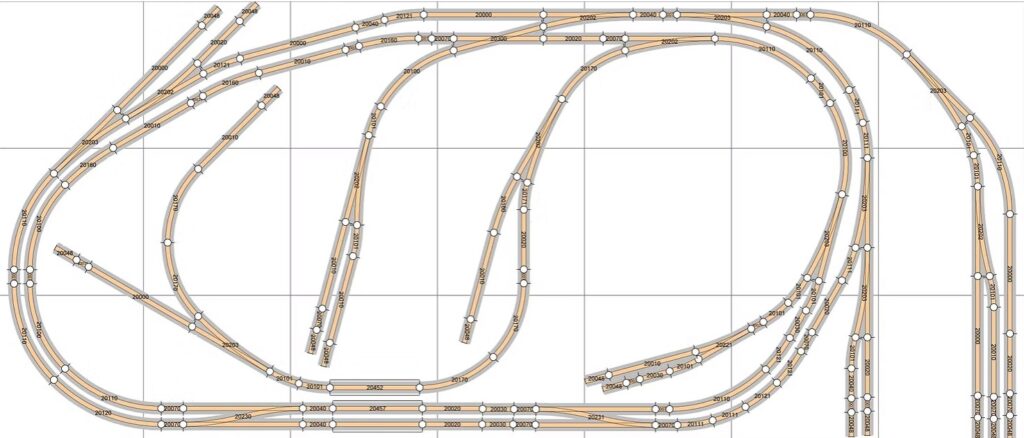
Eric, the Chicago Crossing Model Railroad (CCMR) builder freely admits that the 3′ x 7′ size, with little option to extend, has severely reduced the options of the original plan which is based on industrial Chicago Railroading in 1997. There are only 7 industries on the original CCMR but by extending the layout size to a 4′ x 8′ I have increased the number of industries to 13 and have been able to enhance the basic plan considerably.
My plan of course has to be related to the larger Denver’s RailRoads layout which is based on the six class one railroads – D&RGW, C&S, CB&Q, AT&SF, UP and the Chicago, Rock Island and Pacific Railroad, also known as “The Rock” and the CRI&P – that entered Denver on a daily basis in the transition period leading up to the creation of Amtrak and Burlington Northern in 1970.
As much as I like the Rio Grande I needed a much smaller prototype for this much smaller layout and over time I have become fond of the plain brown and orange colour scheme used by the Rock Island before 1970 and I have 10 diesel switchers, Alco, EMD, GE and FM painted in that scheme or the earlier plain dark red scheme.
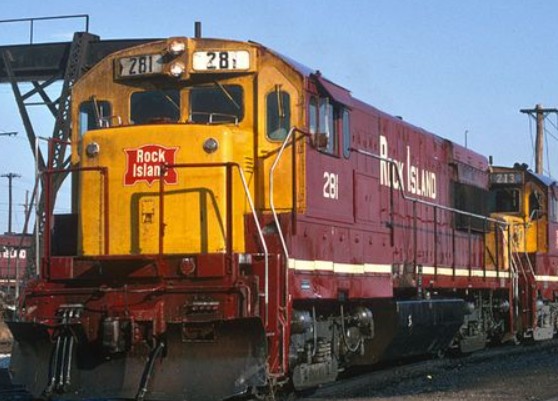
General Electric U28B #281, followed by GE U25B #213.
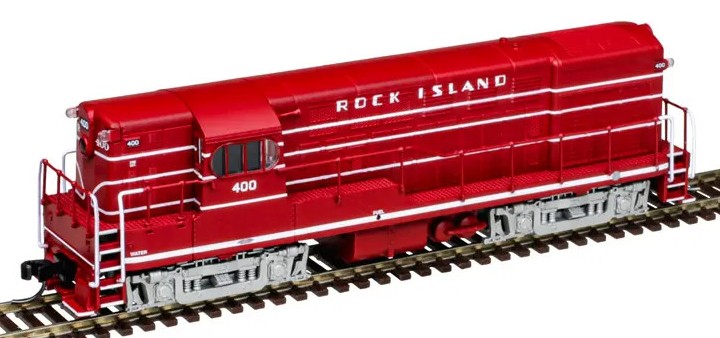
Atlas N scale model of the Fairbanks-Morse H-15-44 #400 which was mainly assigned to Chicago suburban service but on the Rock Island Railroad will pull both passenger and freight service.
The Rock Island railroad first secured entry into Denver in 1889 through a trackage rights agreement with the Union Pacific to use their line from Limon. However, starting in 1950, the railroad entered Denver at the North End of D&RGW’s newly built North Yard from a cut-off that began at Sandown Jct., just west of Denver’s Stapleton Field airport and continued for 4 miles to Belt Jct., where the railroad connected to the Northwest Terminal Railroad, also known as the East Denver Belt Line. The Rock Island purchased two separate parcels of land along the line, the 151-acre Airlawn Industrial District and the 66-acre Sandown Industrial area.
This Rock Island line directly enters the Rio Grande North Yard (modeled as part of Denver’s RailRoads) and by 1969, had nearly 50 separate industries located at Airlawn. In addition, they built a piggyback and multi-level automobile facility at Sandown. Both locations are easily modeled on the 4′ x 8′ expanded layout of the original 3′ x 7′ CCMR trackplan.
The most important change to the original CCMR trackplan was to increase the depth from 3′ to 4′. This extra depth enabled me to add two additional long tracks between the branch line and the two track main line making in effect a 4 track Duban Yard and the Sandown piggyback and multi-level automobile facility. Even in N scale a 3′ depth severely limits the track curvature whereas a 4′ depth enables quite broad curves. Kato unitrack further enhances the choice of curves. If I was going to build the layout with Peco flexible track I would have been limited, on the two track main line, to using two 3′ lengths of track, making an 18″ to 21″ curve. By using Kato unitrack I was able to join a variety of curved track, using 14″ and 15″ curves for the tight side of the double track loop and 19″ curves for the broader loop into the Duban Yard tracks. I also used 11″ curved unitrack at the tighter entrance to the Northwest Terminal Railroad. And thanks to the quality Kato unitrack system you know that most trains will run on any of its curved track pieces.
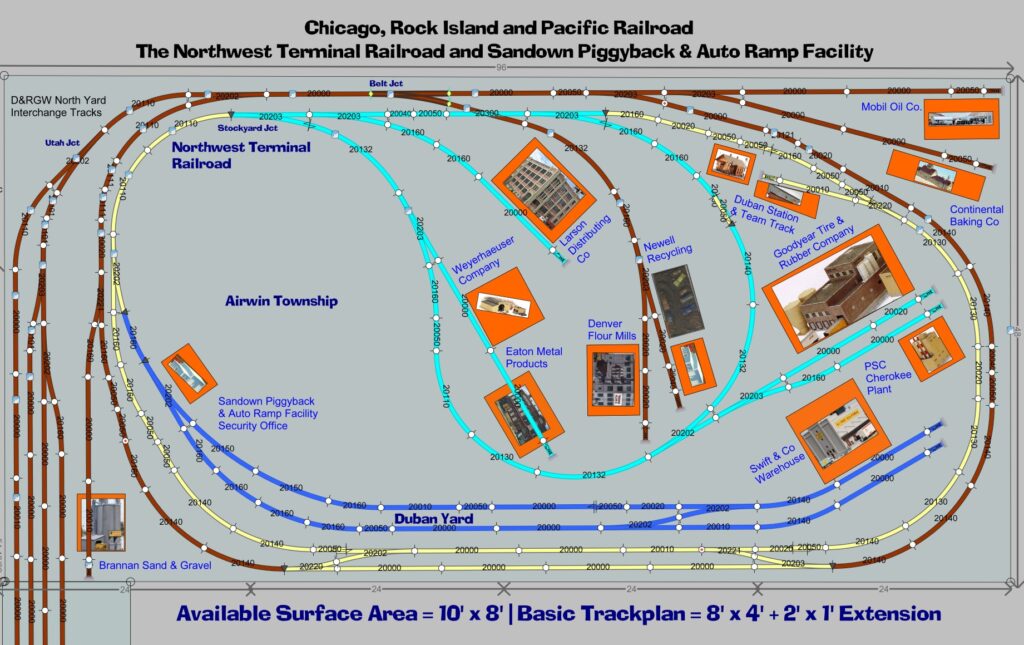
The following is the “final” trackplan, as of 16th June 2026. As can be seen I have flipped the original plan so as to represent the Rio Grande North Yard in its correct geographical location. Furthermore, I have managed, pretty much by accident, to create a return loop with the branch line. Although this will complicate the electrical wiring it will significantly enhance the operational options of the trackplan. At the moment the plan includes a level cross over at Belt Jct., however I plan to build the track shown in dark red around the outside of the trackplan about 2″ higher than the other track and consequently cross the branch line on a bridge.