N Scale
Recording the progress of building the Denver’s RailRoads N Scale layout
All genuine posts are welcomed and will be acknowledged. Please submit your first post by email to: dennis@denversrailroads.com
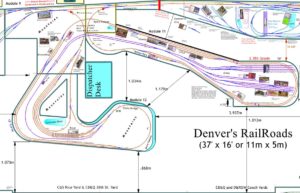
Updated Denver’s RailRoads Track Plan
As long as the track has not actually been laid the Denver’s RailRoads track plan is open to change! The latest change is the moving of Module 12 down by about 18″ giving an aisle space of about 3′ (1m) all the way around the module. A large area of 4m x 1.8m (12′ x 5′) has also been created in the Prospect Junction area. Although I am tempted to add more track I do not intend to do so, or at least not before the current track is laid as planned. Having said that, the movement of Module 12 to increase the aisle space between Modules 11 and 12 has resulted in an increase of 11″ – 21″ to the tracks departing Bond for Glenwood Springs and for the passing siding going into Gore Canyon. This siding, or passing track, can now hold 36 40′ freight cars, 2 Locomotives and a Caboose.
Given that the Winter Park to Granby passing track can hold a 48 car train my goal of running trains of around 20-30 freight cars is very doable. The staging tracks at Grand Junction can hold trains of between 25-30 cars. The staging tracks on the Joint Line are shorter but 3 tracks can hold 25 car trains. The snip below shows the new positioning of Modules 11 & 12. To view the latest version of the full track plan click here.
Finally the Walls are Up and Denver’s RailRoads new home is ready for business
Our new 42′ x 22′ (13m x 7m) layout room is ready. Ultimately it will house my 37′ x 16′ N Scale layout built as an island with a 3′ aisle all the way around and a large 4′ (1.3m) aisle in the centre together with a 12′ x 8′ (3.8m x 2.4m) crew lounge area. The layout will be the exact same configuration as the old Townsville layout, expect that the Prospect Jct. module 5b (see track plan at https://denversrailroads.com/Denver/DR-Layout/DR110.JPG) is now 3′ wider and consequently the tracks have been re-designed to take advantage of the extra space and to create a better Wye at the entrance to Denver Union Station.
A longer run could have been created by building the layout against the walls of the Garage. However that would have meant a module depth of only 18″. By building the layout as an island the full 3′ depth can be utilised. This design choice is particularly effective for the Denver Union Station and return loop modules.
Unfortunately the Garage must be used to store household furniture and the like until the Home is built later this year. But once all that stuff is removed the outside modules should bolt back together with a minimum of effort as they were placed in the container with their legs intact. The centre modules had to be transported without their legs so will be somewhat challenging to connect to the outside modules.
Denver’s RailRoads gets a new home
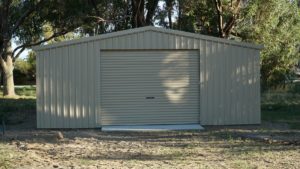
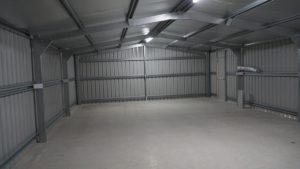
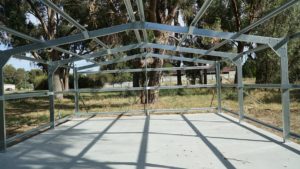
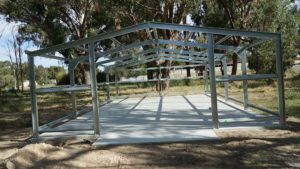
Right on schedule the framework for our new 13m x 7m stand-alone garage/shed home for Denver’s RailRoads has started and is expected to be completed by next Wednesday 8th April 2020.
No windows and only one large rolla-door for moving the modules in. Unfortunately the shed will have to be to store our furniture for the time being. But hopefully I will at least be able to set up a work table for kit making and coupler replacements.
Railroad Activity Timeline since 1850
I have now posted the entire “Railroad Activity since 1850” onto the web site at https://denversrailroads.com/Timeline.htm. You can find it on the reference>general reference information tab.
There are 153 events listed by date and by group. Groups include manufacture dates for 50/60s locos, complete trailer activities, fallen flag dates and name trains that ran through Denver. This should help anyone trying to create a prototype railroad in the 50-70s period.
A New Home for Denver’s RailRoads
Installation will commence on April 3, 2020 for our new 13m x 7m stand-alone garage home for Denver’s RailRoads in Western Australia. On the other hand we are still waiting for the house plans to go with the garage! It is hoped that some of the modules from the old layout will be delivered and set up soon, but they may have to wait until the house is complete. However I am expecting that I can start building and painting kits in earnest long before then.
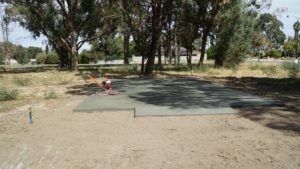
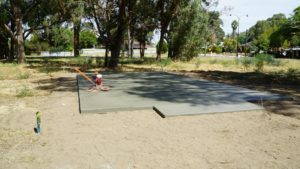
Yesterday, the foundation was poured for our new 13m x 7m stand-alone garage home for Denver’s RailRoads in Western Australia.
Photographs, documenting our progress, will be published as developments occur.
Re-organisation of Construction Phases
The following are the Construction Phases for 2020:
- Phase 1: Modules 1-5a – Joint Line Loop and Denver Union Terminal; CB&Q/D&RGW Coach Yards; UP & CB&Q 23rd St Shops; C&S Rice Yard; UP Wynkoop Street Branch and D&RGW Burnham Shops
- Phase 2: Modules 5b-9 – Main Line from Salt Lake City Loop to Utah Jct. & East Denver Belt Line; D&RGW North Yard & Industries; UP 36th Yard
- Phase 3: Modules 10-12 – Coors Brewery Branch, Glenwood Springs Industrial District and D&RGW Moffat Line & Craig Branch
I will be updating the information on the main web site as time permits.
13m x 7m (42′ x 23′) Garage Plans submitted for Council Approval
We have today submitted plans to our local council in Western Australia to build a 13m x 7m (42′ x 23′) Garage to house the Denver’s RailRoads layout. If approved I can set up the old Denver’s RailRoads layout, which measured 12m x 6m, without any changes to the basic plan. However the extra one meter (39″) to both the length and width means that I can make the following enhancements to the layout:
- The redesign of the tracks entering Denver Union Terminal Station (DUT) from the North and East including the Wye used to turn passenger trains so that they could back in to the station.
- The addition of the Union Pacific 36th Street yard and the Pullman yard.
- Widening the aisle width between module 12 and module 3 from 1.3 feet to 4.3 feet.
Life is full of changes
For the last eight months or so our house has been up for sale and finally it sold late in 2019. My wife wanted to move to a colder, less humid, climate and we agreed on Mandurah, just south of Perth in Western Australia, where I have family (and help lifting layout modules). As part of our negotiations it was agreed that we would buy a house and land big enough to house my 12m x 6m layout as is. That was easier said than done but we have now purchased a 1991 square meter block of land which according to the Mandurah city councils web site should mean that I can build a 13m x 7m garage, not only large enough to house the old layout but also large enough to allow me to extend the layout where it needs it (in the Denver freight yard) and to increase the width of the center aisle.
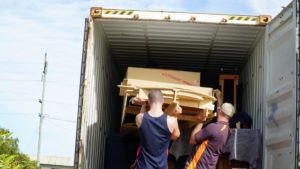
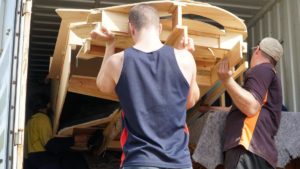
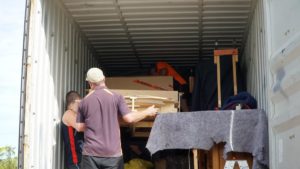
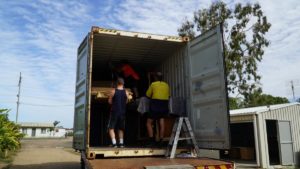
The following photos are of the removal of the “mountain” module (Gore Canyon) from my garage and into the 20′ container. There were 8 modules in total loaded into the containers. Only this module and one other are without legs. Both are inner modules that do not form part of the continuous run around the outside. So it should be fairly quick and “easy” to reconnect the modules that run around the outside and have an operating layout. The inner modules can be added at a later date.
View from the back.
View from the side.
View from the front before we realised that to get it into the container with a minimum of fuss we would need to take the legs off.
Legless module going up the ramp and into the container
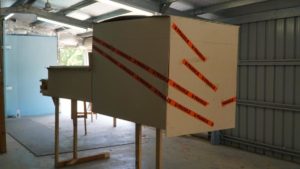
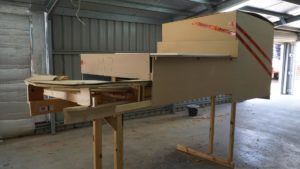
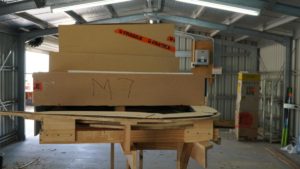
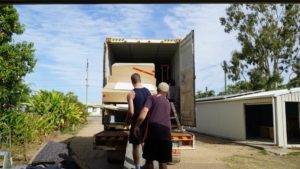
A bit more in.
And more.
And even more.
And finally into the container. Now we have to start thinking about getting it out and back on to it’s legs!
Phase II . . . Only 6 tracks left to lay
Finished installing the last of the turnouts in D&RGWs North Yard last night. Only have the 4 service tracks and 2 industry tracks left to lay.
Then it is onto wiring, wiring and a lot more wiring. Model RailRoading is fun! Still I am looking forward to constructing the control panels. Best part (together with scenery) of the hobby for me.
New areas to explore include controlling main line turnouts via DCC and installing signals. I found a really nice 3 light Chinese made N Scale signal (3 pack) at Amazon for only $11AUD each. Normally N Scale signals cost around $30 each so I have 27 more in transit to me. Plus I have 20 Drawf N Scale Signals (in packs of 10) coming for installation at DUT as part of Phase III.
Phase III Update
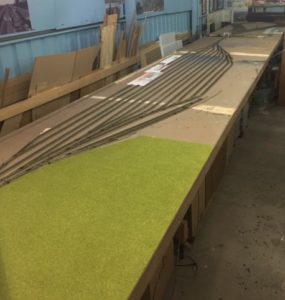
Thanks to the hard work of Rod and John all of the Denver Union Terminal (DUT) tracks have been laid and SEEP turnout motors have been installed – wired and tested – under the baseboard. Now onto the laying of the tracks for C&S’s Rice Yard and the passenger coach yards.